Replace, Don't Reform · One Card, One Cure

A Case for Single-Payer Healthcare

Why the current system can't be reformed, and what already exists to replace it

The United States spends 17.7% of GDP on healthcare — about $15,000 a person a year — and finishes last among wealthy nations on outcomes.

Two books make the case in full: one for why the financing architecture itself has to go, the other for the state-level bill already drafted to replace it.

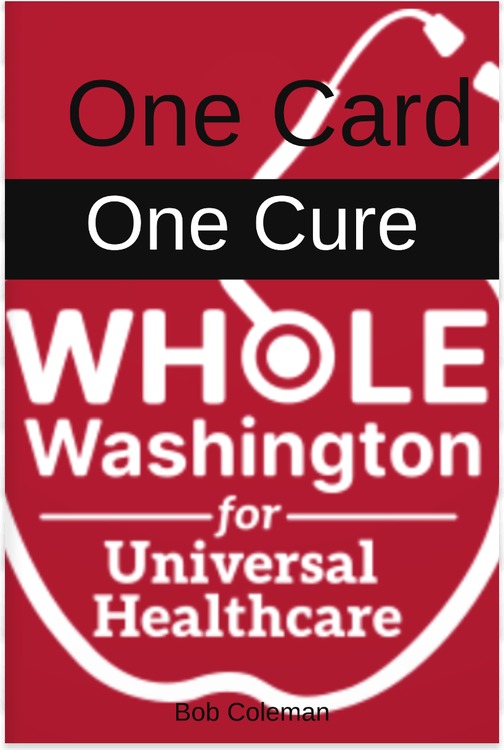
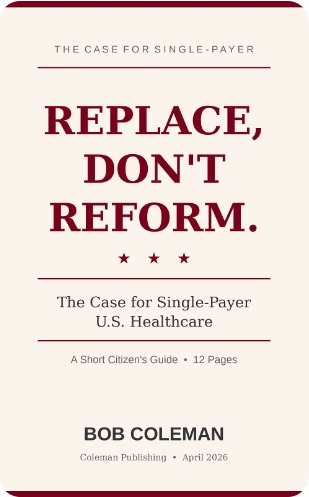
Replace, Don't Reform: The Case for Single-Payer U.S. Healthcare — book cover One Card, One Cure: The Washington Health Trust and the Plan to Heal American Healthcare — book cover

The Problem

What Americans pay for

17.7%Of GDP spent on healthcare — higher than any peer nation.
$15,000Per person, per year — about twice the peer average.
~1/3Of every healthcare dollar goes to administration, not care.

The lowest life expectancy in the G7. The highest maternal mortality among peer nations. Medical debt is the number one cause of personal bankruptcy in the United States. An estimated 85 million adults are uninsured or underinsured.

No other wealthy country produces this combination of outcomes. That distinctiveness is the clue.

“We spend the most. We get the least. That is not dysfunction. That is the design.”— Replace, Don't Reform

The Denial Machine

The engine of the system's profitability is denial. Insurers earn more by paying out less.

82%Of Medicare Advantage prior-authorization denials are overturned on appeal.
<1%Of denials are ever appealed. The system is profitable because patients give up.

AI algorithms now mass-deny claims — inpatient stays in particular — in seconds. An estimated 68,000 preventable deaths a year are linked to inadequate coverage.

“An 82% overturn rate is not a quality control system. A quality control system catches errors before they happen. This system makes them deliberately, and only stops when someone fights back.”— Replace, Don't Reform

The Prescription

What single-payer is — and isn't

Single-payer is a way of financing healthcare. It is not a way of delivering it.

What it is

  • Every resident is covered automatically. One card. One plan.
  • One public payer finances care — as Medicare already does for people over 65.
  • Hospitals and doctors remain independent. Patients choose their own.
  • Premiums, deductibles, co-pays, and surprise bills are eliminated.
  • Financed through progressive, predictable contributions — not premiums that rise faster than wages.

What it is not

  • Not "government-run hospitals." Canada has single-payer; its hospitals are mostly independent.
  • Not a loss of choice. You pick your doctor. You stop picking between insurance companies.
  • Not untested. Every wealthy democracy uses some version. The U.S. already runs two — Medicare and the VA.

The Evidence

The case, by the numbers

The most persistent myth is that single-payer would cost more. The evidence does not support that.

The economics

FindingSource
Of 22 modeled single-payer systems, project net savings in year one86% — PLOS Medicine, 2020
Reduction in total national health spending, modeled~9.6% — PERI, UMass Amherst
Annual savings if U.S. administrative spending matched peer nations$400–500 billion

The proof already running

The VA is already a single-payer system. It covers nine million veterans, and by peer-reviewed measures it outperforms comparable private-sector care: a 46% reduction in 28-day mortality and roughly 21% lower cost than Medicare-financed private hospital care, among dually-eligible veterans studied. It is being targeted for privatization not because it is failing, but because it is succeeding.

“No serious ethical framework supports the proposition that a person's access to necessary medical care should depend on whether a corporation finds that care profitable to authorize.… It becomes profitable because it is unethical.”— Replace, Don't Reform

Objections

The myths, answered

The claimThe evidence
"Wait times will skyrocket."U.S. wait times are already long, at the prior-authorization stage. Peer countries have comparable or shorter urgent-care waits.
"We can't afford it."Peer-reviewed modeling shows net savings. The issue is not total spending — it is the share consumed by extraction.
"You'll lose your doctor."Under single-payer, you pick any doctor. What you lose is the insurer network.
"It's socialism."Medicare is single-payer. The VA is single-payer. Every wealthy democracy has one. All remain functioning capitalist economies.
"Taxes will go up."For most Americans, taxes replace — and are lower than — current premiums, deductibles, and co-pays.
"Government bureaucracy is worse."Medicare overhead: 2–3%. Private insurance overhead: 12–18%.
"Innovation will collapse."Most foundational U.S. drug research is NIH-funded. Peer countries continue producing world-class research.
"Americans don't want it."Stable majority support — 77% of Black Americans, 71% of women under 50, 74% of adults under 30.

The Path

Two futures

American healthcare will be restructured. It is being restructured already. The only question is the direction.

Path one

Continued erosion of public coverage. Steady privatization of what works. Expansion of the denial architecture. Coverage as an unstable privilege, renegotiated every political cycle.

Path two

Replacement of the extraction layer. Medicare and the VA expanded into a unified national framework. State models built where the federal path is blocked — including the Washington Health Trust.

Only one path produces a functioning system. States already moving: Washington, Oregon, California, New York, Colorado, Minnesota, New Mexico.

“The federal floor is collapsing. The state ceiling is rising. That gap is where reform now lives.”— Replace, Don't Reform

The Blueprint

The plan already exists

One Card, One Cure is the deep dive into the leading state-level model: Washington's Health Trust Act (HB 1445 / SB 5233), drafted, economically analyzed, and ready for a vote.

Four features

  • Unified public funding. Replaces fragmented funding streams — state employee plans, Medicaid, ACA subsidies — with a single publicly accountable pool, financed by a dedicated capital gains tax and payroll contributions.
  • Simplified coverage. One card, one claims system. The administrative bloat that consumes an estimated 31% of spending is redirected to patient care.
  • Wraparound Medicare. Covers deductibles, copays, and gaps — including dental, hearing, and vision — so no senior loses benefits and everyone gains financial security.
  • Veteran-friendly integration. Covers what the VA does not — emergency care outside the network, dental, vision, family member care — without forcing veterans to choose between systems.

The three-phase national blueprint

  1. The Legislative Beachhead (Years 0–2). The Washington Health Trust itself — a working model in one state, built to be replicated.
  2. The Public Choice (Years 2–4). Other states adopt the same framework as a premium, integrated public option.
  3. The Federal Synthesis (Years 4–6). A national system built by synthesizing these state models with Medicare and the VA — not by disrupting them.
“In short, it's not about starting from scratch, but about finally getting it right.”— One Card, One Cure

The Case, In Two Parts

Read both books

Replace, Don't Reform: The Case for Single-Payer U.S. Healthcare book cover

Kindle eBook · 2026 · A Short Citizen's Guide

Replace, Don't Reform

The Case for Single-Payer U.S. Healthcare

The diagnosis: why the U.S. spends the most and gets the least, why fifty years of incremental reform keeps getting absorbed by the same extraction layer, and why replacing the financing architecture — not patching it again — is the only path that works.

Get it on Kindle →
One Card, One Cure: The Washington Health Trust and the Plan to Heal American Healthcare — book cover

eBook · 2026 · The Washington Health Trust

One Card, One Cure

The Washington Health Trust and the Plan to Heal American Healthcare

The blueprint: the specific, drafted legislation that turns the diagnosis into a working model — one card, one claims system, wraparound Medicare, and a three-phase path from one state to the whole country.

Read the eBook →

The case is documented. The blueprint is drafted.

What's missing is the vote.

“The takeover was engineered. So can the reversal.” — Replace, Don't Reform