Kindle eBook
Broken Trust
COVID-19 and the Cost of Certainty
About the book →Broken Promises Healthcare · 2026
The Crisis Inside NIH, CDC, and HHS
On October 1, 2000, the CDC declared measles eliminated from the United States. In 2025, four Americans died of it — three of them children.
This book is an investigation into the distance covered between those two facts.
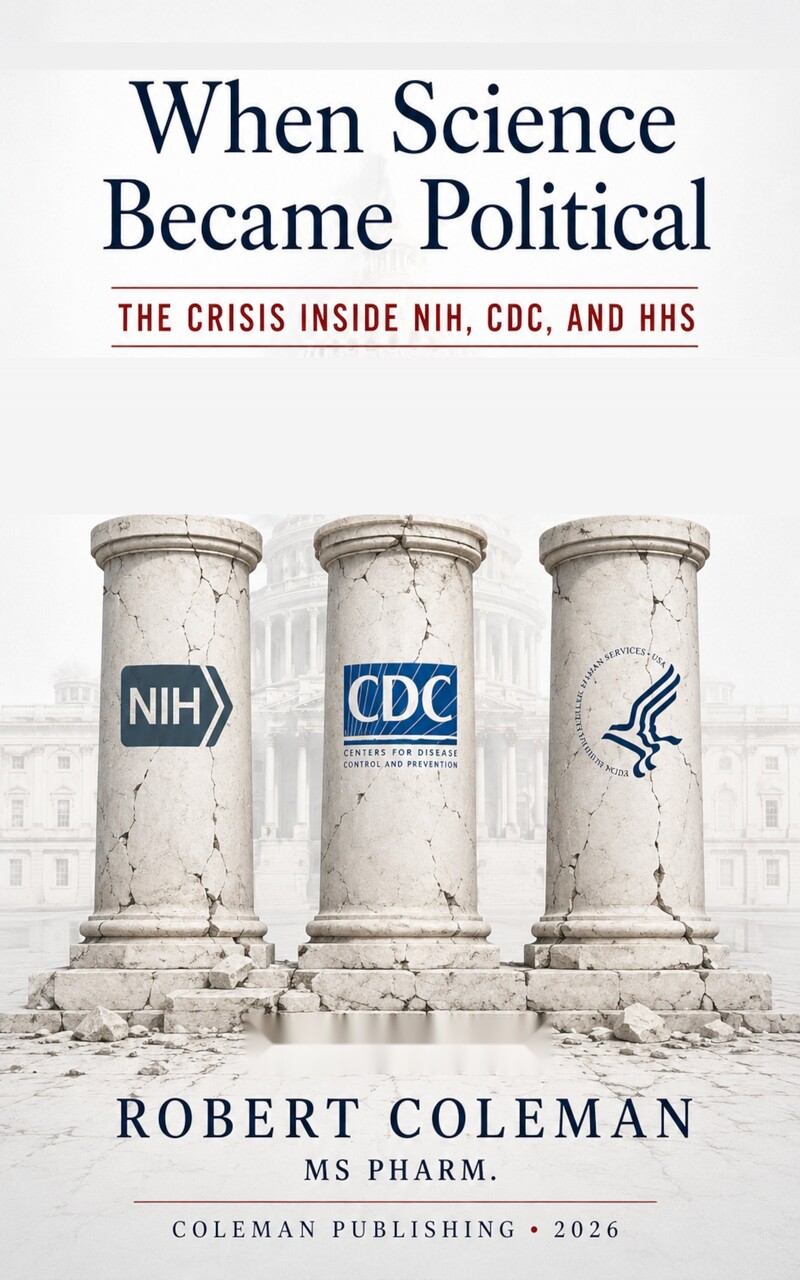
The National Institutes of Health, the Centers for Disease Control and Prevention, and the Department of Health and Human Services. Their decisions shape vaccine policy, outbreak response, medical research priorities, and the health of hundreds of millions of people.
In 2025 those institutions were reshaped — rapidly, and by people whose public records had already drawn concern from large parts of the scientific and medical community.
When Science Became Political documents what happened. Who was appointed, and how. What they had claimed, and what the evidence shows about those claims. What they then did to the agencies. And what has followed — not in projection, but on the record.
“The evidence is not merely a warning about the future. It is a description of the present.”— Foreword
The narrator is an investigator. Not an activist, not a partisan, not an ideologue. Every significant factual statement is sourced, and the notes say plainly where evidence is contested, where a model carries uncertainty, and where a public official has a legitimate grievance.
The science is explained, not simplified. Where a chart teaches faster than a paragraph, there is a chart.
It argues something narrower and harder: that specific claims were tested at scale, by independent researchers, and found unsupported — and that acting on them anyway has a measurable cost.
The Evidence
One of the four was Daisy Hildebrand. She was eight years old. She was unvaccinated. She had no underlying conditions. The MMR vaccine is 97% effective after two doses, and it was freely available.
In one Gaines County, Texas school district, the vaccine exemption rate was 46.36%. Nationally, kindergarten MMR coverage has fallen to 92.7% from 95.2%. Measles needs 95% to stop moving. The arithmetic is not negotiable.
| Between February 2025 and May 2026 | Documented |
|---|---|
| CDC workforce eliminated within weeks of February 13, 2025 | ~25% |
| Sitting members of the vaccine advisory committee fired, June 9, 2025 | all 17 |
| Federal public health surveillance databases disrupted or taken offline | 38 of 82 |
| Tenure of the confirmed CDC director before removal | 29 days |
| NIH research grants terminated | 2,291 — $2.45B |
| Clinical trials disrupted, and patients enrolled in them | 383 — 74,000+ |
| FDA commissioners and vaccine-division directors in 14 months | 2 and 2 |
| Former FDA commissioners who published a joint objection | 12, both parties |
A $766 million pandemic influenza contract was cancelled in May 2025, during an active H5N1 outbreak. Twenty-two mRNA contracts worth $500 million were cancelled — covering influenza, RSV, HIV, cytomegalovirus, and cancer immunotherapy, not only COVID.
“An absent vaccine produces no press release, no Senate hearing, no named victim.”— Chapter 11
The measured figures above are documented events. Projections elsewhere in the book are peer-reviewed models with stated uncertainty ranges, and the book reports the ranges rather than the headline number alone.
Contents
Conclusion — The Ledger. What was done, what the science shows, what rebuilding requires.
The book does not end in despair, because the record does not support despair.
Congress rejected the proposed 40% cut to the NIH. A federal court found the childhood schedule reduction unlawful. The American Academy of Pediatrics issued an independent vaccine schedule, endorsed by twelve organizations representing more than a million clinicians. Twenty-eight states decoupled from federal guidance. New Mexico ran sixty mobile clinics, drove a 55% increase in MMR uptake, and ended its outbreak.
“The children do not choose. The adults responsible for the systems designed to protect them do.”— Conclusion
Measles was eliminated from this country in 2000. A 97% effective vaccine has existed since 1963.
In 2025, four Americans died of it — three of them children.
Every figure on this page is documented in the book. Content current through May 12, 2026.